Table of Contents
- Introduction
- What is Generative AI (Gen AI)?
- Key Capabilities of Generative AI
- Popular Generative AI Tools
- What is Agentic AI?
- Core Characteristics of Agentic AI
- Real Examples of Agentic AI
- Gen AI vs Agentic AI: Key Differences for Businesses
- Why This Difference Matters for Enterprises
- Business Use Cases of Generative AI
- Business Use Cases of Agentic AI
- Gen AI vs Agentic AI: Impact on Business Strategy
- Challenges of Gen AI in Enterprises
- Challenges of Agentic AI
- How xCroTek Helps Businesses Adopt Gen AI & Agentic AI
- Gen AI or Agentic AI: Which Should Your Business Choose?
- Future of Gen AI and Agentic AI in Business
- Conclusion: The Real Difference That Matters
- Call-to-Action (CTA)
- FAQ
Introduction
Artificial Intelligence is evolving faster than any technology wave before it. Businesses are already using Gen AI tools like ChatGPT, Claude, and Gemini to automate content, customer support, and coding. But a new paradigm is emerging-Agentic AI, where AI systems don’t just generate outputs, they take actions autonomously.
At xCroTek, we’ve worked with enterprises exploring both Generative AI and Agentic AI, and the confusion is common: Are they the same? Which one should businesses adopt?
This guide breaks down the real differences between Gen AI and Agentic AI, their business impact, and how enterprises can strategically adopt them.
What is Generative AI (Gen AI)?
Generative AI refers to AI systems that create new content, data, or outputs based on patterns learned from massive datasets.
Key Capabilities of Gen AI
- Text generation (emails, reports, blogs)
- Image and video creation
- Code generation
- Data summarization
- Conversational AI (chatbots)
Popular Gen AI Tools
- ChatGPT
- Google Gemini
- Claude AI
- Midjourney / DALL·E
- GitHub Copilot
Gen AI is reactive-it responds when a user prompts it.
What is Agentic AI?
Agentic AI refers to AI systems that autonomously plan, decide, and execute tasks without continuous human input.
Unlike Gen AI, Agentic AI behaves like a digital employee or autonomous agent.
Core Characteristics of Agentic AI
- Goal-driven behavior
- Autonomous task execution
- Memory and learning over time
- Multi-step decision-making
- Integration with tools, APIs, and workflows
Real Examples of Agentic AI
- AI agents that manage IT incidents
- Autonomous marketing campaign optimizers
- AI procurement agents negotiating vendor pricing
- Automated DevOps deployment agents
Gen AI vs Agentic AI: Key Differences for Businesses
| Feature | Generative AI | Agentic AI |
| Primary Function | Generate content | Take actions autonomously |
| Human Interaction | Requires prompts | Works independently |
| Decision-Making | Minimal | High-level autonomous |
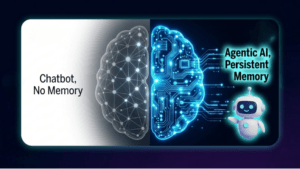
| Memory | Limited | Persistent contextual memory |
| Enterprise Use | Productivity tools | Autonomous workflows & operations |
Why This Difference Matters for Enterprises
Gen AI boosts productivity.
Agentic AI changes how businesses operate.
At xCroTek, enterprise clients are shifting from AI copilots to AI coworkers.

Business Use Cases of Gen AI
- Customer Support Automation
Gen AI chatbots handle FAQs, tickets, and conversational queries.
- Marketing Content Creation
- Blogs
- Social media posts
- Ads and copywriting
- Software Development
AI code assistants accelerate development cycles.
- Data Insights
Summarizing reports, extracting trends, and generating dashboards.
Business Use Cases of Agentic AI
1. Autonomous IT Operations
AI agents detect outages and auto-resolve incidents.
2. Sales & CRM Automation
AI agents manage leads, follow-ups, and pipeline updates.
3. Financial Forecasting
Autonomous agents analyze market data and adjust investment strategies.
4. HR & Recruitment
AI agents shortlist candidates, schedule interviews, and onboard employees.

Gen AI vs Agentic AI: Impact on Business Strategy
Gen AI Impact
- Reduces manual tasks
- Improves productivity
- Enhances creativity
Agentic AI Impact
- Replaces repetitive decision-making
- Reduces operational costs
- Enables 24/7 autonomous operations
- Creates AI-driven organizations
According to McKinsey, AI automation could add $4.4 trillion annually to global productivity.
(Source: https://www.mckinsey.com)

Challenges of Gen AI in Enterprises
- Data privacy risks
- Hallucinations and inaccuracies
- Compliance and governance concerns
- Dependency on prompts
Challenges of Agentic AI
- Ethical concerns
- High implementation complexity
- Security risks if agents act autonomously
- Need for governance frameworks
Gartner predicts that by 2028, 15% of daily enterprise decisions will be made by AI agents.
(Source: https://www.gartner.com)
How xCroTek Helps Businesses Adopt Gen AI & Agentic AI
At xCroTek, we design enterprise-ready AI solutions with governance, security, and scalability at the core.
Our Expertise Includes
- Enterprise AI strategy consulting
- Custom AI agent development
- AI-powered workflow automation
- Secure Gen AI deployments
- AI governance frameworks
We ensure businesses move from AI experimentation to AI transformation.
Gen AI or Agentic AI: Which Should Your Business Choose?
Choose Gen AI if:
- You need productivity tools
- Your workflows are human-driven
- You want fast ROI with minimal risk
Choose Agentic AI if:
- You want autonomous operations
- You manage large-scale workflows
- You aim for AI-driven digital transformation
Most enterprises will use both together.
Future of Gen AI and Agentic AI in Business
The future is hybrid AI ecosystems where:
- Gen AI creates knowledge
- Agentic AI executes decisions
This will redefine enterprise roles, productivity, and organizational structures.
Conclusion: The Real Difference That Matters
Generative AI creates. Agentic AI acts.
For businesses, this difference is massive. Gen AI boosts productivity, while Agentic AI reshapes operations and decision-making.
Companies that adopt both strategically will lead the AI-powered economy.
Call-to-Action (CTA)
Ready to transform your business with enterprise AI?
Contact xCroTek today for AI consulting, custom AI agents, and enterprise-ready Gen AI solutions.
Visit: www.xcrotek.com
Email: contact@xcrotek.com
FAQ
1. What is the main difference between Generative AI and Agentic AI?
Generative AI creates content such as text, images, and code based on prompts, while Agentic AI can plan, decide, and take actions autonomously without continuous human input.
2. Is Agentic AI the same as autonomous AI?
Agentic AI is a type of autonomous AI, but it specifically focuses on goal-driven agents that execute tasks, make decisions, and interact with systems or tools independently.
3. Which is better for businesses: Gen AI or Agentic AI?
Neither is universally better.
- Gen AI is ideal for productivity and content generation.
- Agentic AI is best for automating workflows and decision-making.
Most enterprises will use both together.
4. Can Agentic AI replace human employees?
Agentic AI can automate repetitive tasks and decision workflows, but it is designed to augment human teams, not fully replace them. Human oversight and governance are still required.
5. What are common business use cases of Generative AI?
Common use cases include:
- Customer support chatbots
- Marketing content creation
- Code generation
- Data summarization and reporting