Explore how memory architecture defines the real divide between AI chatbots and agentic AI systems in 2025 , and why it matters for your business.
Table of Contents
- 1. Introduction
- 2. What Is Memory in AI?
- 3. How Chatbots Handle Memory , And Where They Fall Short
- 4. The Four Types of Memory in Agentic AI
- 5. Chatbots vs. Agentic AI: A Side-by-Side Comparison
- 6. Why Memory Is the Real Game-Changer for Enterprises
- 7. Real-World Use Cases: Memory in Action
- 8. The Role of MCP in Enabling Persistent Agent Memory
- 9. Challenges and Risks of Agent Memory
- 10. How xCroTek Builds Memory-Driven Agentic AI
- 11. FAQ
- 12. Conclusion
Introduction
There is a conversation happening across boardrooms, development teams, and innovation labs in 2025 , and it is not about which AI model is smarter. It is about which AI actually remembers.
For years, the dominant image of AI in enterprise software was the chatbot: a responsive, rule-following assistant that handled FAQs, routed service tickets, and answered product questions at scale. Chatbots delivered real value. But they also had a very visible ceiling. Every new conversation started from scratch. Every user had to re-explain who they were. Every session was, in the truest technical sense, a blank slate.
That limitation is now the single most important dividing line between a basic AI system and a truly intelligent one. Memory , how AI stores, retrieves, and builds on past interactions , is what separates reactive chatbots from proactive, goal-driven agentic AI systems.
At xCroTek, we have seen this shift play out directly with the enterprises we work with. When AI systems start to remember , users, context, past decisions, and business workflows , adoption accelerates, efficiency soars, and trust compounds. In this article, we will break down exactly how memory works in AI, why it matters more than most organizations realize, and what it means for businesses exploring agentic AI in 2025.
What Is Memory in AI?
When most people think of AI memory, they think of chatbot context , the system knowing what you said three messages ago. That is one kind of memory, but it is the most primitive kind.
In AI research and engineering, memory refers to the ability of a system to store, retrieve, and act on information across time. This includes information from the current session, past sessions, stored user preferences, domain knowledge, and procedural know-how accumulated over repeated interactions.
Key Insight
Large Language Models (LLMs) are stateless by design. They do not remember anything between API calls. Every session starts fresh unless a separate memory layer is deliberately built and connected to the model.
This is a crucial point for businesses evaluating AI tools. The intelligence of the underlying model , whether GPT-4, Claude, or Gemini , is only one part of the equation. The memory architecture layered on top determines whether the system grows smarter with every interaction or resets to zero every time.
How Chatbots Handle Memory , And Where They Fall Short
Traditional chatbots , and even modern LLM-powered chat interfaces , typically operate with what engineers call session-level or context-window memory. This means the AI can reference anything said within the current conversation, but once that conversation ends, the information is gone.
Here is what this looks like in practice: A customer contacts a support chatbot about a billing issue. The bot resolves it. Two weeks later, the same customer returns with a follow-up. The chatbot has no idea who they are, what was discussed, or what was resolved. The customer has to start over.
This is not a minor inconvenience , it is a structural failure in the experience. And it is entirely a memory problem, not an intelligence problem.
Modern AI-powered chatbots have improved significantly over their rule-based predecessors. They understand intent, parse natural language with high accuracy, and handle more complex conversations. But they remain fundamentally reactive and stateless without deliberate memory engineering.
- No recall of past user interactions after a session ends
- Cannot build personalized context over time
- Must be retrained or manually updated to incorporate new knowledge
- Operate on predefined workflows , they do not create or adapt them
- Cannot coordinate across multiple tools or systems autonomously
These constraints are tolerable for simple, high-volume, transactional use cases , FAQ bots, basic order tracking, ID verification. But for anything requiring genuine personalization, multi-step reasoning, or autonomous action, a chatbot architecture will eventually hit a wall.
The Four Types of Memory in Agentic AI
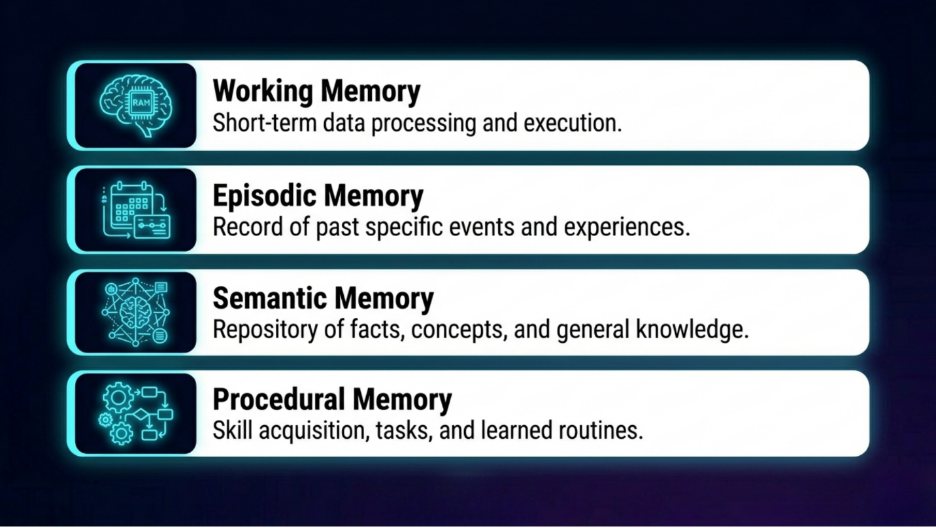
Agentic AI systems are built on a fundamentally different memory model. Rather than relying on a single context window, they integrate multiple memory types that mirror how human cognition actually works. Researchers and engineering teams have converged on four primary categories:
1. Working Memory
Working memory is the AI equivalent of short-term recall during an active task. It holds the current conversation context, the goals being pursued in the present session, and the immediate inputs the agent is processing. This is the memory type chatbots also use , but in agentic systems, it connects to the layers below rather than standing alone.
2. Episodic Memory
Episodic memory stores records of past interactions and events. When a customer contacts support for the fourth time about an account issue, an agentic AI with episodic memory can surface all prior interactions, previous resolutions, and outstanding items. This is the memory type most directly responsible for personalization and continuity across sessions.
3. Semantic Memory
Semantic memory houses knowledge about entities, preferences, and relationships. This includes things like customer industry verticals, product preferences, communication styles, and organizational structures. Unlike episodic memory (which records events), semantic memory captures stable facts and characteristics that inform how the agent should behave.
4. Procedural Memory
Procedural memory encodes workflows, resolution paths, and operating protocols. It tells the agent not just what happened, but how to respond , which escalation path to follow, which tool to call, which approval sequence to initiate. This is especially powerful in enterprise automation, where consistent process adherence is non-negotiable.
All Four Working Together
Customer service is currently the most common enterprise use case for agentic AI (26.5% of production deployments as of 2025, per LangChain’s industry survey). Effective customer service agents require all four memory types working in concert: episodic recall for past tickets, semantic knowledge of customer preferences, procedural memory for resolution workflows, and working memory for the live interaction.
Chatbots vs. Agentic AI: A Side-by-Side Comparison
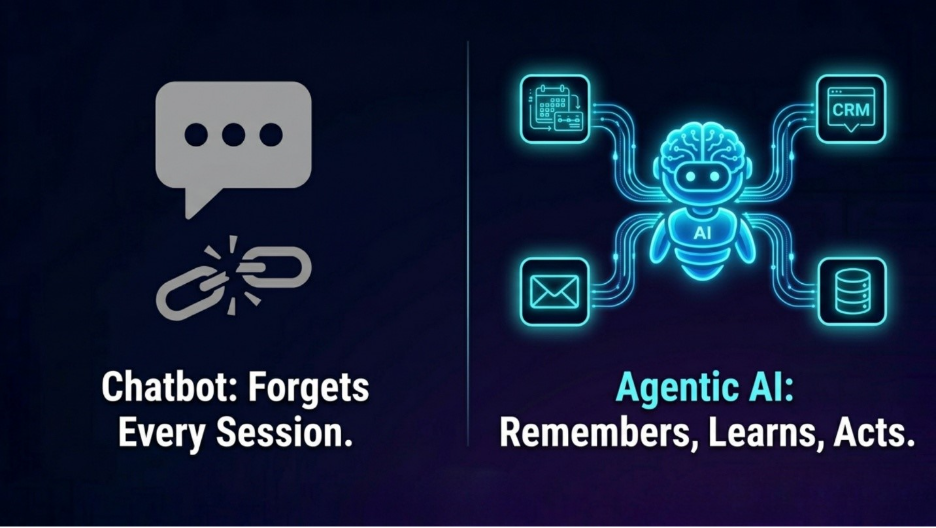
| Feature | Chatbot | Agentic AI |
| Memory | Session-only, resets after chat ends | Persistent across sessions and users |
| Autonomy | Reactive , waits for user input | Proactive , plans & initiates tasks |
| Task Scope | Single, predefined tasks | Multi-step, goal-oriented workflows |
| Learning | Static (manual updates by devs) | Adapts in real-time from interactions |
| Tool Use | Limited or none | Full tool orchestration (APIs, apps) |
| Context Depth | Shallow , within one conversation | Deep , spans weeks, months of history |
| Decision Making | Rule-based or scripted | Autonomous reasoning & planning |
The table above makes the architectural gap clear. These are not differences of degree , they are differences of kind. A chatbot and an agentic AI system solve fundamentally different problems, and memory architecture is the technical reason why.
Why Memory Is the Real Game-Changer for Enterprises
Enterprise leaders evaluating AI investments in 2025 are increasingly focused on a simple question: does this system get better as we use it, or does it stay the same? Memory is what separates a static tool from a learning system.
Consider three enterprise scenarios where memory architecture determines outcomes:
Scenario 1: Personalized Customer Engagement
A financial services firm deploys an AI model for customer onboarding. Without memory, every customer interaction is generic , the AI asks the same questions, provides the same paths. With persistent semantic and episodic memory, the system remembers that this specific customer is risk-averse, has previously expressed interest in ESG products, and last engaged during a market downturn. The experience becomes genuinely tailored, not just automated.
Scenario 2: IT Operations Automation
An enterprise IT team implements AI for incident management. A stateless chatbot resolves tickets one by one, with no cross-ticket learning. An agentic AI system with procedural and episodic memory recognizes recurring failure patterns, escalates intelligently based on past resolution history, and proactively surfaces systemic issues before they become outages. The same team handles significantly higher ticket volumes with greater accuracy.
Scenario 3: Long-Running Project Management
A professional services firm uses AI to support project delivery. A chatbot can answer questions about the current project. An agentic AI can track progress across multiple projects over months, flag deviations from historical delivery patterns, and adapt resource recommendations based on what has worked in similar past engagements. This is only possible because the system remembers.
The Role of MCP in Enabling Persistent Agent Memory
One of the most significant infrastructure developments enabling memory-driven agentic AI in 2025 is the Model Context Protocol (MCP) , an emerging standard that allows AI systems to connect seamlessly with external tools, databases, calendars, file storage, and communication platforms.
Think of MCP as a universal connector , the AI equivalent of USB-C , that makes it technically feasible for an agent to move context, preferences, and historical data fluidly from one application to another. Without a standardized memory infrastructure like MCP, each tool integration requires custom development, creating fragile, hard-to-maintain AI systems.
With MCP in place, an agentic AI can retrieve a customer’s email history, cross-reference their calendar, check their CRM record, and summarize their last support interaction , all in a single workflow , before responding to their current request. This is not science fiction; it is what enterprise-grade agentic AI systems are delivering today.
For deeper reading on AI memory infrastructure and governance, refer to the New America Policy Brief on AI Agents and Memory and the NIST AI Risk Management Framework for governance considerations.
Challenges and Risks of Agent Memory
Building persistent memory into AI systems is not without complexity. Enterprises deploying agentic AI need to understand and actively manage several risk areas:
- Security: Memory Poisoning
Adversarial actors can inject false or misleading information into an agent’s memory store, corrupting future decision-making. Robust access controls and memory validation are essential.
- Regulation: Data Privacy and Compliance
Persistent user memory creates significant data retention obligations under frameworks like GDPR and emerging AI regulations. Clear data lifecycle policies must govern what is stored, for how long, and under what conditions it is deleted.
- Architecture: Multi-Tenancy Isolation
In enterprise environments serving multiple teams or clients, memory must be rigorously scoped , per user, per team, per organization , to prevent cross-contamination of context and data.
- Operations: Complexity and Cost
KPMG’s 2025 survey of C-suite leaders found that 65% cite agentic system complexity as the top barrier to deployment. Memory architecture , choosing the right vector databases, graph stores, and relational layers , is a significant engineering investment.
- Accountability: Governance Gaps
As agentic AI systems accumulate memory and autonomy, questions of accountability become more pressing. Organizations need clear policies on what decisions agents can make independently versus which require human approval.
How xCroTek Builds Memory-Driven Agentic AI
At xCroTek, we design agentic AI systems from the memory layer up. Our experience working with enterprises across sectors , from financial services to logistics to professional services , has shaped a clear approach: memory is not a feature you add to AI. It is the foundation you build AI on.
Our implementation methodology focuses on four core principles:
- Memory-First Architecture: We architect persistent memory infrastructure before building agent logic , not the other way around.
- Governance by Design: Every memory system we deploy includes role-based access controls, audit logging, and retention policies aligned with regulatory requirements.
- Iterative Learning Loops: We build feedback mechanisms so agents improve from every interaction, not just from periodic retraining cycles.
- Human Oversight Integration: Our agentic systems include configurable approval workflows, ensuring humans remain in the loop for high-stakes decisions.
Explore how we approach intelligent automation in our related article: AI Technology Transparency: Beyond Black Boxes to Trustworthy AI. For our perspective on multi-agent collaboration, see: Agentic AI: How Multi-Agent Collaboration and RAG Are Shaping the Future.
For Deeper Research, Refer To:
• NIST AI Risk Management Framework: https://www.nist.gov/itl/ai-risk-management-framework
• EU AI Act Overview: https://digital-strategy.ec.europa.eu/en/policies/european-approach-artificial-intelligence
• LangChain 2025 State of AI Agents Report: https://www.langchain.com/stateofaiagents
• Oracle Developer Blog , Agent Memory: https://blogs.oracle.com/developers/agent-memory-why-your-ai-has-amnesia-and-how-to-fix-it
FAQ
Q1: What is the main difference between a chatbot and an agentic AI?
The core difference is memory and autonomy. Chatbots are reactive and stateless , they respond to prompts within a single session with no recall of past interactions. Agentic AI systems maintain persistent memory across sessions, can proactively plan multi-step workflows, use external tools, and autonomously pursue goals without requiring constant human instruction.
Q2: What are the four types of memory in agentic AI?
The four memory types are: working memory (current session context), episodic memory (records of past interactions), semantic memory (knowledge about users, entities, and preferences), and procedural memory (workflows and operational protocols). All four are necessary for a truly capable agentic AI system.
Q3: Is agentic AI ready for enterprise deployment in 2025?
Yes, with proper governance and architecture. Enterprise deployments of agentic AI have more than doubled from Q1 to Q4 of 2025 according to industry research. However, most large enterprises are still in early stages , the key barriers are system complexity, memory infrastructure, and governance frameworks, not the underlying AI technology.
Q4: How does memory affect AI personalization?
Memory is the engine of personalization. Without persistent memory, AI can only personalize within a single session based on what you tell it in real time. With episodic and semantic memory, an agentic AI builds a continuously richer model of each user , their preferences, history, communication style, and goals , enabling experiences that genuinely improve over time.
Q5: What is MCP, and why does it matter for AI agents?
MCP (Model Context Protocol) is a technical standard that allows AI agents to connect with external tools, applications, and data sources in a standardized way. It acts as a universal infrastructure layer that makes persistent memory practical at scale , enabling agents to retrieve and act on context from calendars, emails, CRMs, and databases in a single workflow.
Q6: How can businesses ensure their AI agent memory is secure?
Security requires memory isolation by user and team, strict access controls, audit logging, and protection against memory poisoning attacks. Compliance with data regulations (GDPR, emerging AI frameworks) demands clear retention and deletion policies. Organizations should work with partners who design governance into memory architecture from the start.
Conclusion: Memory Is the Moat
The AI landscape in 2025 is not primarily a competition between language models. The real differentiation is architectural , specifically, how well AI systems remember, learn, and build on what they know over time.
Chatbots have earned their place in the enterprise stack, and they will continue to serve high-volume, transactional use cases effectively. But for organizations that want AI systems capable of genuine autonomy, deep personalization, and compounding intelligence, the upgrade path runs directly through memory.
Agentic AI systems with robust memory architecture do not just answer questions , they build understanding. They do not just complete tasks , they develop expertise. They do not just respond , they remember, adapt, and improve.
The businesses investing in memory-driven agentic AI today are building something that their competitors cannot easily replicate: an AI system that gets smarter the longer it runs. That is not just a technical advantage. It is a strategic one.
🚀 Ready to Build AI That Remembers?
Whether you’re exploring your first agentic AI deployment or scaling an existing system, xCroTek designs memory-driven AI solutions built for enterprise performance and governance. Contact xCroTek today , let’s architect an AI system that grows smarter every day. Visit: www.xcrotek.com