Agentic AI: Why Everyone Is Moving Beyond LLMs

Agentic AI is the next big leap beyond large language models. Learn how autonomous AI systems plan, act, and deliver real results and why businesses are embracing agentic AI in 2026 and beyond.

Agentic AI: Why Everyone Is Moving Beyond LLMs​

Introduction

Imagine an AI that doesn’t just answer your questions but actually gets things done.

  • Not just writing a plan, but breaking it into steps.
  • Not just suggesting tools, but using them.
  • Not just stopping at a response, but following through until the goal is complete.

That’s exactly what agentic AI promises and it’s why companies are starting to move beyond traditional large language models (LLMs).

In this guide, we’ll break down what agentic AI really is, how it works, where it’s already being used, and why it’s shaping the future of work.

Agentic AI: Why Everyone Is Moving Beyond LLMs​

What Is Agentic AI?

At its core, agentic AI is about initiative.

Traditional LLMs respond when you prompt them. Agentic AI goes further, it can decide what to do next, take action on its own, and work toward a defined goal.

Think of the difference like this:

  • An LLM is a smart consultant.

  • Agentic AI is a proactive teammate.

Agentic AI systems combine language models with planning, memory, tools, and feedback loops. This allows them to operate more like human assistants—handling complex, multi-step tasks with minimal supervision.

Agentic Framework

Instead of stopping at an answer, agentic AI keeps going, evaluating progress, adjusting decisions, and learning along the way.

The Shift From LLMs to Agentic AI Systems

LLMs changed how we interact with AI, but they were never designed to act in the real world.

Agentic AI systems are different. They’re built specifically for execution.

Rather than waiting for constant human input, these systems:

  • Work toward clear objectives

  • Decide the best next action

  • Use tools and data sources independently

  • Adapt based on results

This shift is happening because businesses don’t just want smarter answers anymore they want measurable outcomes.

Agentic AI (the concept) describes autonomy and goal-driven behavior.
Agentic AI systems (the reality) are how that concept turns into real business value.

What Makes Agentic AI Different?

Agentic AI stands out because of a few defining traits:

  • Goal-oriented behavior
    Everything it does is tied to an objective—not just a prompt.

  • Self-directed planning
    It breaks big problems into smaller steps without being told how.

  • Tool and system interaction
    It can call APIs, query databases, write code, or trigger workflows.

  • Feedback and self-correction
    Results are evaluated, mistakes are fixed, and performance improves over time.

These capabilities make agentic AI especially powerful in fast-changing environments where adaptability matters.

The Role of AI Agents

Agentic AI doesn’t exist without AI agents.

AI agents are the operational layer that sits on top of the LLM. They provide:

  • Planning and reasoning

  • Memory and context retention

  • Tool usage and execution

  • Feedback loops and decision logic

Without agents, AI mostly talks.
With agents, AI acts.

That’s what enables end-to-end automation, from idea to execution.

Role of AI Agents

Without agents, AI mostly talks.
With agents, AI acts.

That’s what enables end-to-end automation, from idea to execution.

Real-World Applications of Agentic AI

Agentic AI is already being used across industries, often quietly transforming how work gets done.

Some common use cases include:

  • Research and analysis
    Automatically gathering data, validating sources, and generating insights.

  • Content creation and management
    Drafting, revising, publishing, and maintaining long-form content with minimal input.

  • Software development
    Writing code, fixing bugs, testing, and deploying updates autonomously.

  • Personal productivity
    Managing emails, schedules, reports, and follow-ups so teams can focus on strategy.

  • End-to-end process automation
    From HR workflows to supply chains, agentic AI handles entire processes—not just pieces.

  • Customer support and operations
    Resolving issues, escalating intelligently, and providing real-time assistance.

Healthcare, finance, retail, and logistics are seeing especially strong results, but almost any knowledge-based workflow can benefit.

Why Businesses Are Betting on Agentic AI

The impact of agentic AI goes beyond speed—it changes how work happens.

Key benefits include:

  • Higher productivity
    A growing share of daily decisions and actions can be automated.

  • Lower operational costs
    Less manual effort means fewer bottlenecks and reduced overhead.

  • Faster innovation
    Teams spend less time on repetitive tasks and more time on creative problem-solving.

  • More reliable outcomes
    Feedback loops and grounded decision-making reduce errors and hallucinations.

Agentic Ai Market growth

The rapid growth of the agentic AI market reflects one thing clearly: companies that adopt early gain a serious competitive advantage.

Challenges to Keep in Mind

Agentic AI isn’t plug-and-play, at least not yet.

Organizations need to think carefully about:

  • Data privacy and security

  • Bias and ethical safeguards

  • Human oversight for high-risk decisions

  • Integration with existing systems

  • Regulatory compliance

The smartest approach is to start small, run pilots, learn fast, and scale responsibly.

What the Future Looks Like

Agentic AI is moving quickly toward:

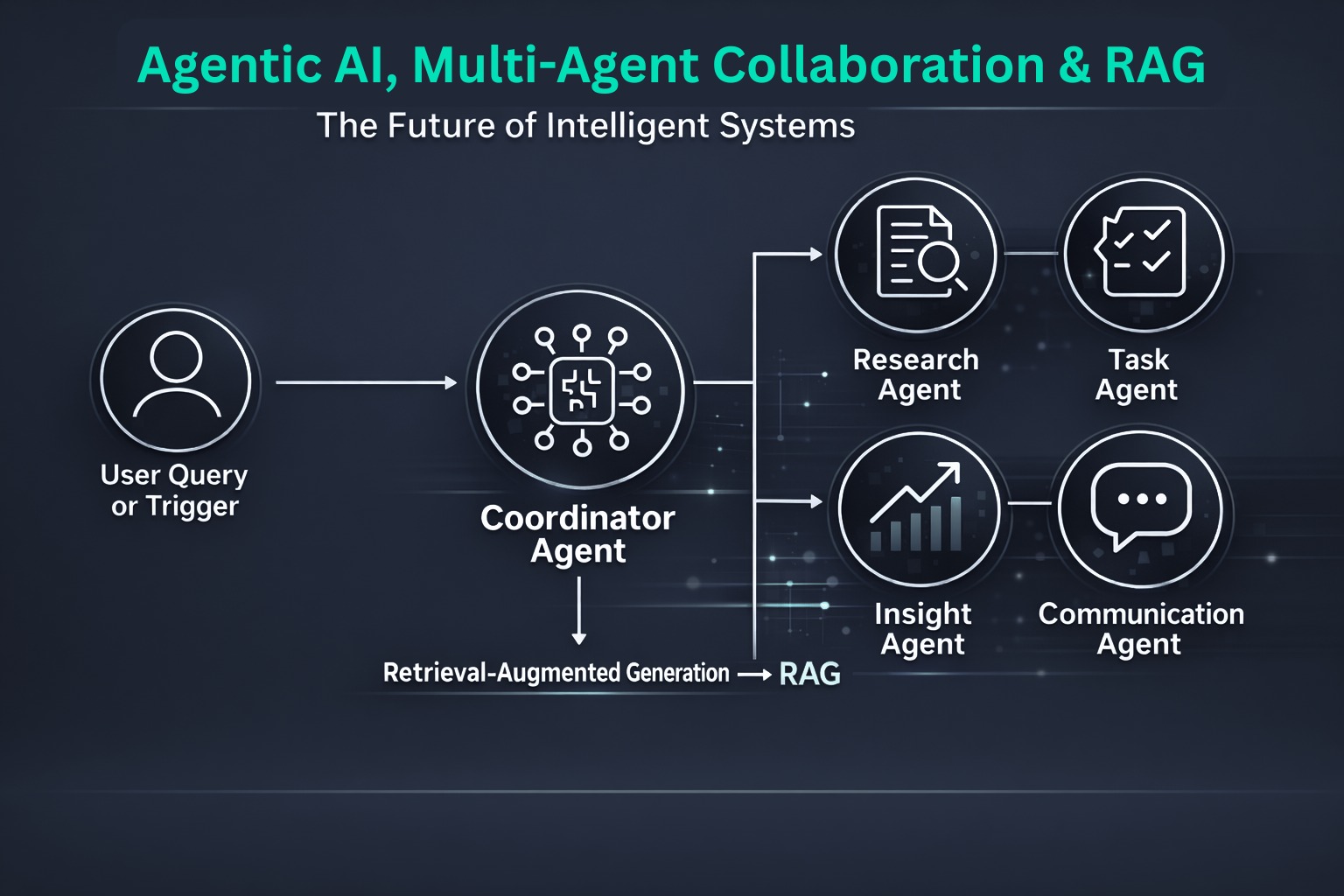
  • Multi-agent systems that collaborate

  • Real-time learning and adaptation

  • Deep integration into enterprise workflows

Multi-agent systems

As these systems mature, they’ll act less like tools and more like digital coworkers, amplifying human capabilities rather than replacing them.

Final Thoughts

Agentic AI isn’t just another AI trend. It’s a fundamental shift from systems that respond to systems that take responsibility for outcomes.

By moving beyond LLMs, organizations unlock a new level of automation, efficiency, and innovation.

The question isn’t if agentic AI will become standard, it’s how soon you’ll start using it.

FAQ

Q1: How is agentic AI different from traditional LLMs?
Agentic AI can plan, act, use tools, and self-correct; LLMs mainly generate responses.

Q2: How should businesses get started?
Start with small pilots in areas like support or research, then scale gradually.

Q3: Is agentic AI safe for enterprise use?
Yes, when deployed with governance, security controls, and human oversight.

Q4: Which industries benefit the most?
Finance, healthcare, retail, software, logistics, and operations-heavy sectors.

Q5: Will agentic AI replace jobs?
No. It augments people by handling routine work so humans can focus on higher-value tasks.

LinkedIn
Email
Phone
WhatsApp
WhatsApp
Phone
Email
LinkedIn